5 July 2026 · The Rosco Team
How often should architects bill clients? Why billing frequency is a cash flow strategy, not admin
When our practice started, we billed by phase — and it nearly broke our cash flow. Here is what running a small studio taught us about why billing frequency is one of the most important practice-management decisions you make.
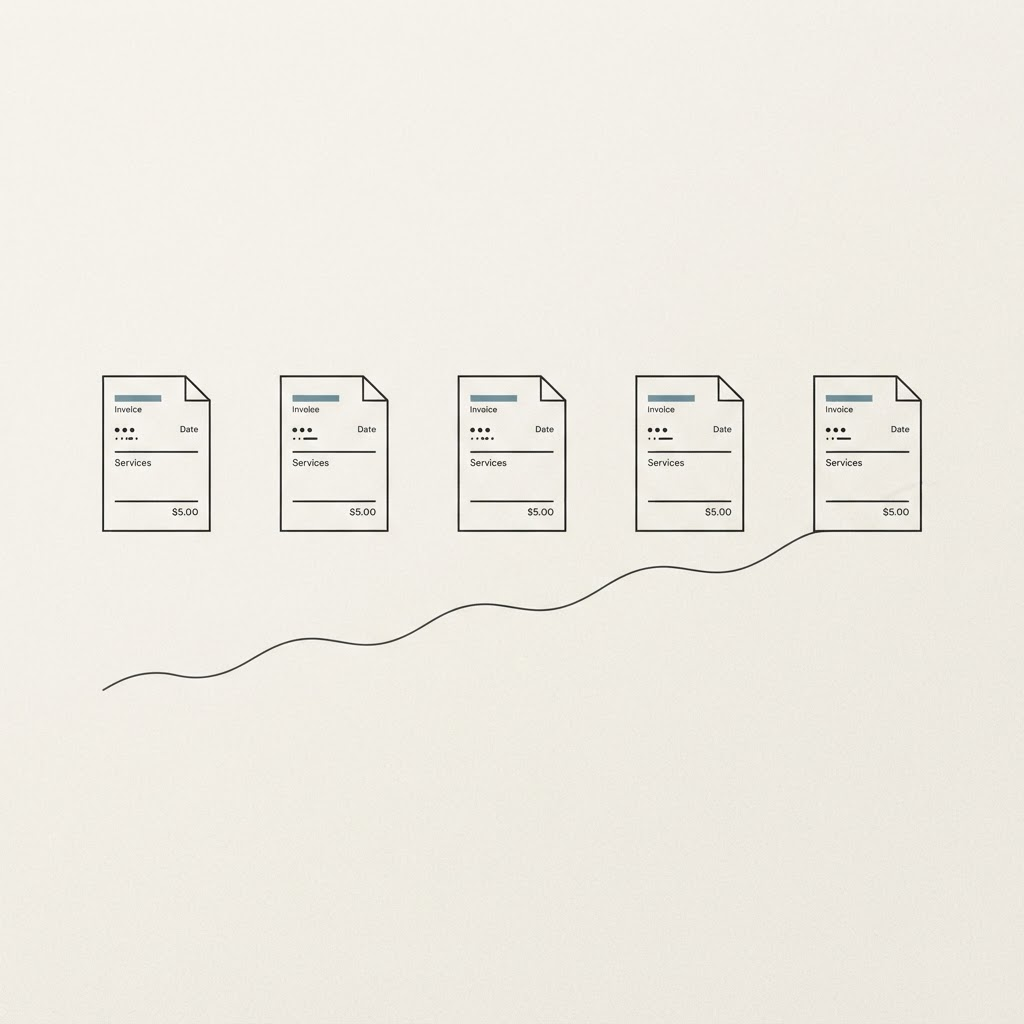
From the Rosco journal — what running a small studio teaches you about practice management.
When our practice started, we billed the way most small studios do: by phase, or whenever it felt like a natural moment to send an invoice. Sometimes that was every couple of months. Sometimes it was whenever someone remembered to do it.
It felt reasonable at the time. It also nearly broke our cash flow — and it's one of the clearest lessons that shaped how we approached practice management at every stage afterward, and ultimately, part of why we built Rosco.
The real cost of infrequent billing
Infrequent billing creates a particular kind of risk: you do weeks of work before finding out whether the relationship is actually working — whether the client pays on time, questions your hours, or pays at all. By the time a $6,000 invoice lands on someone's desk, you've usually been carrying that cost for a month or more, with your own subcontractors, software subscriptions and rent due regardless of whether you've been paid.
This isn't just a small-practice problem — it's structural. In 2024, around 92% of construction-sector businesses reported issues with overdue invoices, the highest of any sector measured. Late payments now affect more than half of all invoices issued by Australian SMEs. For a lot of small studios, slow payment isn't a once-off inconvenience. It's a structural feature of how the industry runs — and one of the main reasons architecture firms start looking for project management software for architects or dedicated billing tools in the first place.
We didn't fix the problem by chasing harder. We fixed it by changing when and how often we asked to be paid — and, eventually, by building the system to make that automatic.
Smaller, more frequent invoices change the relationship
Once we moved to fortnightly or monthly billing, two things happened almost immediately.
Cash flow stabilised. Instead of one large, lumpy invoice every couple of months, we had a predictable, regular claim moving through the business. It's a small operational shift with an outsized effect on how much runway a small studio actually has at any given time.
Smaller invoices got paid faster, with far fewer questions. A $1,200 fortnightly invoice barely registers as a decision for most clients. A $9,000 invoice for two months of "design development," with no itemisation anyone can quickly cross-reference against what they remember happening, invites scrutiny — not because the work wasn't done, but because the size of the ask changes how carefully a client has to think before approving it.
A smaller, regular invoice is something a client can understand and approve almost reflexively. A large, infrequent one forces them to stop, think, and often ask questions you'll then need to answer before you get paid.
"It's only a small invoice, I'll wait until it's bigger" is the wrong instinct
It's a common instinct in a small studio to talk yourself out of sending invoices early on — telling yourself a $900 invoice isn't worth the admin, that you'll bundle it into the next one and make it "worth sending." That instinct is understandable, but it's backwards. Every delayed invoice does two things: it extends the time before you're paid for work you've already done, and it quietly raises the size — and therefore the friction — of whatever invoice eventually does go out.
Billing regularly, even for small amounts, isn't extra admin. It's the thing that keeps admin small. It also shows the client, consistently, exactly what they're paying for and when.
This isn't just good practice — it's industry standard. Payment terms and the structure of fee claims are central enough to the architect-client relationship that they're explicitly built into the Australian Institute of Architects' standard Client Architect Agreement, which provides for a claim for payment to be submitted each month as default practice. Regular billing isn't a workaround. It's the industry default for a reason — and it's exactly the kind of recurring, predictable workflow that practice management software is designed to handle automatically, rather than relying on someone remembering to raise an invoice.
Get the first invoice out early, ideally before the bulk of the work starts
The other shift that mattered just as much: getting paid before doing significant work, not after.
It's common, and entirely reasonable, for design practices to require a deposit before any work begins. This does two useful things at once. It tells you, early and cheaply, what kind of payer you're dealing with — before you've sunk weeks into planning research, site visits and early client meetings. And it sets the tone of the relationship from day one: the work the client is receiving is something they've engaged and paid for, not something offered speculatively in the hope of winning their trust.
This isn't a quirk of architecture. It's standard across professional services. Most consultants — lawyers, engineers, accountants — work on a similar logic: a deposit before work starts, balance on delivery. Requiring upfront payment before committing real hours to a project isn't aggressive or unusual; it's how the rest of the consulting world already operates. Asking for one as a small or new practice can feel like you haven't yet earned the right to — but in practice, it's simply aligning yourself with how every other professional service already runs.
It's worth knowing this isn't just convention, either — it's backed by legislation. In New South Wales, the Building and Construction Industry Security of Payment Act 1999 gives contractors and suppliers — including architecture and design consultants — a legal right to claim progress payments, regardless of what the contract says. Equivalent legislation exists in every Australian state and territory, and these protections can't be contracted out of. The right to be paid progressively for work as it's delivered isn't just good practice. It's a right the law already gives small studios.
Why we built billing frequency into Rosco
None of this is about chasing clients harder or being less generous with your time. It's the opposite — billing regularly, in smaller amounts, starting early, is what lets a small studio stay generous, because you're not quietly underwriting the practice's cash flow with your own stress.
It's also exactly the kind of problem that's easy to understand and hard to stay disciplined about without a system behind it — which is part of why we built Rosco, practice management software built specifically for small architecture practices. Rosco handles recurring billing schedules, progress claims, and fee tracking alongside the project management features architects already expect — so regular billing happens automatically, rather than depending on someone remembering to raise an invoice on top of an already full week.
If you're an architect or small studio principal looking into architecture practice management software, this is usually one of the first problems worth solving — not because it's complicated, but because it's so easy to deprioritise when you're busy doing the actual design work.
This is part of an ongoing Rosco journal on what we've learned running a small studio and building practice management software around the way small architecture practices actually work. Next: what we got wrong about progress claims, and how we fixed it.